line=line,表明“直线,线条”
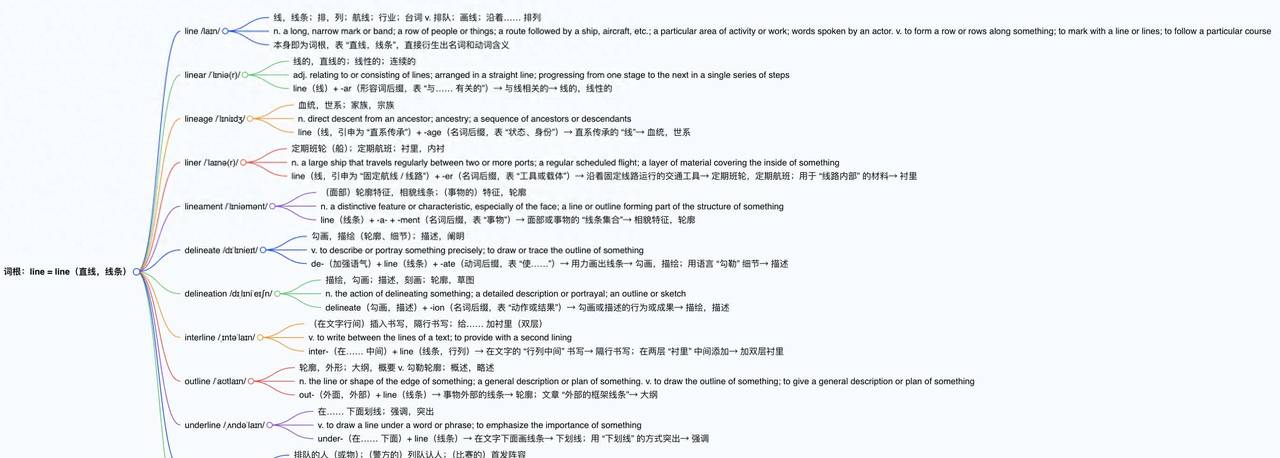
- line /laɪn/
中文释义: 线,线条;排,列;航线;行业;台词 v. 排队;画线;沿着…… 排列。
英文释义: n. a long, narrow mark or band; a row of people or things; a route followed by a ship, aircraft, etc.; a particular area of activity or work; words spoken by an actor. v. to form a row or rows along something; to mark with a line or lines; to follow a particular course.
构词: 本身即为词根,表 “直线,线条”,直接衍生出名词和动词含义。
例句: She drew a straight line on the paper.(她在纸上画了一条直线。)/ People lined up to buy tickets for the concert.(人们排队购买音乐会门票。) - linear /ˈlɪniə(r)/
中文释义: 线的,直线的;线性的;连续的。
英文释义: adj. relating to or consisting of lines; arranged in a straight line; progressing from one stage to the next in a single series of steps.
构词: line(线)+ -ar(形容词后缀,表 “与…… 有关的”)→ 与线相关的→ 线的,线性的。
例句: The company has a linear management structure.(这家公司采用线性管理结构。)/ The plot of the novel follows a linear narrative.(这部小说的情节采用线性叙事。) - lineage /ˈlɪniɪdʒ/
中文释义: 血统,世系;家族,宗族。
英文释义: n. direct descent from an ancestor; ancestry; a sequence of ancestors or descendants.
构词: line(线,引申为 “直系传承”)+ -age(名词后缀,表 “状态、身份”)→ 直系传承的 “线”→ 血统,世系。
例句: He comes from a noble lineage that dates back to the 16th century.(他出身于可追溯至 16 世纪的贵族世家。) - liner /ˈlaɪnə(r)/
中文释义: 定期班轮(船);定期航班;衬里,内衬。
英文释义: n. a large ship that travels regularly between two or more ports; a regular scheduled flight; a layer of material covering the inside of something.
构词: line(线,引申为 “固定航线 / 线路”)+ -er(名词后缀,表 “工具或载体”)→ 沿着固定线路运行的交通工具→ 定期班轮,定期航班;用于 “线路内部” 的材料→ 衬里。
例句: We took a luxury liner across the Atlantic Ocean.(我们乘坐豪华班轮横渡大西洋。)/ The coat has a warm fur liner.(这件外套有保暖的毛皮内衬。) - lineament /ˈlɪniəmənt/
中文释义: (面部)轮廓特征,相貌线条;(事物的)特征,轮廓。
英文释义: n. a distinctive feature or characteristic, especially of the face; a line or outline forming part of the structure of something.
构词: line(线条)+ -a- + -ment(名词后缀,表 “事物”)→ 面部或事物的 “线条集合”→ 相貌特征,轮廓。
例句: Her face has soft, gentle lineaments.(她的面部线条柔和温婉。)/ The architect emphasized the clean lineaments of the building.(建筑师强调了这座建筑简洁的轮廓特征。) - delineate /dɪˈlɪnieɪt/
中文释义: 勾画,描绘(轮廓、细节);描述,阐明。
英文释义: v. to describe or portray something precisely; to draw or trace the outline of something.
构词: de-(加强语气)+ line(线条)+ -ate(动词后缀,表 “使……”)→ 用力画出线条→ 勾画,描绘;用语言 “勾勒” 细节→ 描述。
例句: The map delineates the boundaries of the national park.(这张地图勾勒出了国家公园的边界。)/ The report delineates the main challenges facing the industry.(这份报告阐明了该行业面临的主要挑战。) - delineation /dɪˌlɪniˈeɪʃn/
中文释义: 描绘,勾画;描述,刻画;轮廓,草图。
英文释义: n. the action of delineating something; a detailed description or portrayal; an outline or sketch.
构词: delineate(勾画,描述)+ -ion(名词后缀,表 “动作或结果”)→ 勾画或描述的行为或成果→ 描绘,描述。
例句: The artist’s delineation of the landscape was highly praised.(艺术家对这片景色的描绘备受赞誉。) - interline /ˌɪntəˈlaɪn/
中文释义: (在文字行间)插入书写,隔行书写;给…… 加衬里(双层)。
英文释义: v. to write between the lines of a text; to provide with a second lining.
构词: inter-(在…… 中间)+ line(线条,行列)→ 在文字的 “行列中间” 书写→ 隔行书写;在两层 “衬里” 中间添加→ 加双层衬里。
例句: She interlined her notebook with additional notes.(她在笔记本的行间添加了补充注释。)/ The coat is interlined with wool for extra warmth.(这件外套加了羊毛内衬以增强保暖性。) - outline /ˈaʊtlaɪn/
中文释义: 轮廓,外形;大纲,概要 v. 勾勒轮廓;概述,略述。
英文释义: n. the line or shape of the edge of something; a general description or plan of something. v. to draw the outline of something; to give a general description or plan of something.
构词: out-(外面,外部)+ line(线条)→ 事物外部的线条→ 轮廓;文章 “外部的框架线条”→ 大纲。
例句: We could see the outline of the mountains against the sunset.(我们能看到群山在夕阳下的轮廓。)/ Please outline your plan for the project in the meeting.(请在会议上概述你的项目计划。) - underline /ˌʌndəˈlaɪn/
中文释义: 在…… 下面划线;强调,突出。
英文释义: v. to draw a line under a word or phrase; to emphasize the importance of something.
构词: under-(在…… 下面)+ line(线条)→ 在文字下面画线条→ 下划线;用 “下划线” 的方式突出→ 强调。
例句: The teacher asked us to underline the key points in the text.(老师让我们在课文中划出重点。)/ Her success underlines the importance of hard work.(她的成功突显了努力的重大性。) - lineup /ˈlaɪnʌp/(增补词)
中文释义: 排队的人(或物);(警方的)列队认人;(比赛的)首发阵容。
英文释义: n. a group of people or things arranged in a line; a group of suspects shown to a witness for identification; the list of players in a team for a particular game.
构词: line(排,列)+ up(向上,聚集)→ 聚集排成一列→ 排队的人,阵容。
例句: There was a long lineup at the ticket office.(售票处排起了长队。)/ The team announced their starting lineup for the final match.(球队公布了决赛的首发阵容。) - streamline /ˈstriːmlaɪn/(增补词)
中文释义: 使成流线型;精简(流程、机构),提高效率。
英文释义: v. to design or make something have a smooth shape that reduces resistance to movement through air or water; to simplify a process or organization in order to make it more efficient.
构词: stream(溪流)+ line(线条)→ 具有溪流般平滑的线条→ 使成流线型;让流程像 “直线” 一样顺畅→ 精简。
例句: The new car is streamlined to reduce wind resistance.(这款新车采用流线型设计以减少风阻。)/ We need to streamline the application process to save time.(我们需要精简申请流程以节省时间。)
备注
一、特别说明
- 词根含义的延伸:
“line” 核心为 “直线,线条”,但在构词中可广泛延伸 —— 既指具体的 “线条、行列、航线”(如 line、liner、lineup),也指抽象的 “传承线(血统)、逻辑线(线性)、框架线(大纲)”(如 lineage、linear、outline),甚至通过 “线条的动作” 引申为 “勾画、强调、精简”(如 delineate、underline、streamline),需结合单词语境判断具体指向。 - 多词性与多义现象:
部分单词(如 line、outline、underline)兼具名词和动词词性,且不同词性含义紧密关联(如 outline 作名词表 “轮廓”,作动词表 “勾勒轮廓”);
部分单词(如 liner)有多个具体含义(“定期班轮”“内衬”),需通过搭配(如 “luxury liner”“fur liner”)区分。 - 易混淆同源词:“linear” 与 “lineal”(补充词)均含 “线” 的含义,但 “linear” 侧重 “直线的、线性的”(如 linear logic “线性逻辑”),“lineal” 侧重 “直系的、世袭的”(如 lineal descendant “直系后代”),需注意拼写差异带来的语义区别。
二、记忆方法
- 词根 + 前缀 / 后缀联动:
通过词缀明确 “线条” 的语义方向,快速推导词义:
表 “位置 / 方向”:out-(外面)+ line → outline(外部线条→轮廓);under-(下面)+ line → underline(下面划线→强调);inter-(中间)+ line → interline(行间书写);
表 “抽象含义”:line + -age(状态)→ lineage(传承线→血统);line + -ar(相关的)→ linear(线条相关→线性的);
表 “动作 / 功能”:de-(加强)+ line → delineate(用力画线→勾画);stream + line → streamline(溪流般线条→使流线型 / 精简)。 - 场景分类记忆:
将单词按 “具体事物、抽象概念、动作行为” 分类,强化关联:
具体事物:line(线条)、liner(班轮 / 内衬)、lineup(队列)、lineament(相貌线条);抽象概念:linear(线性的)、lineage(血统)、outline(大纲);
动作行为:delineate(勾画)、underline(强调)、interline(隔行书写)、streamline(精简)。 - 生活化联想记忆:
结合日常场景绑定单词,例如:排队买票→lineup(队列);
画重点划线→underline(强调);
写作文列提纲→outline(大纲);
飞机航线→liner(定期航班),通过场景加深印象。
三、注意点
- 发音细节:
“lineage” 发音为 /ˈlɪniɪdʒ/(重音在首音节,“age” 发 /ɪdʒ/),易误读为 /ˈlɪneɪdʒ/;
“delineate” 发音为 /dɪˈlɪnieɪt/(重音在第二音节),避免读成首音节重音;
“streamline” 发音为 /ˈstriːmlaɪn/,“stream” 和 “line” 连读,不可拆分读成 /striːm laɪn/。 - 易混淆单词辨析:
“delineate” vs “describe”:二者均表 “描述”,但 “delineate” 更侧重 “准确勾勒细节或轮廓”(如 delineate a map “勾画地图”),“describe” 侧重 “用语言全面描述”(如 describe a scene “描述场景”);
“outline” vs “summary”:二者均表 “概要”,但 “outline” 侧重 “文章 / 计划的框架结构”(如 outline of a report “报告大纲”),“summary” 侧重 “内容的浓缩总结”(如 summary of the meeting “会议纪要”)。 - 使用语境限制:
“lineament” 偏书面语,日常描述 “面部特征” 可用 “facial features”,避免用词生僻;
“streamline” 多用于描述 “流程、机构、设计” 的优化,不可用于描述个人行为(如不可说 “streamline my daily routine”,应用 “simplify my daily routine”);
“liner” 表 “定期班轮 / 航班” 时为正式用语,日常可简称为 “ship”“flight”,表 “内衬” 时为通用语,无使用限制。
© 版权声明
文章版权归作者所有,未经允许请勿转载。
相关文章




暂无评论...